 |
||||||||||||||||
Tuesday, 6 January 2015
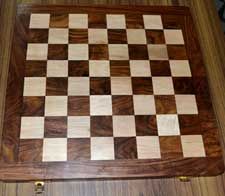
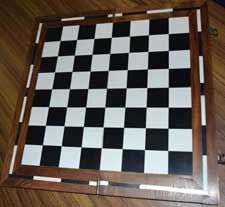
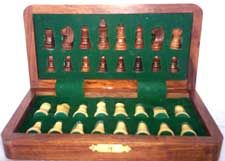
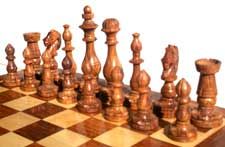
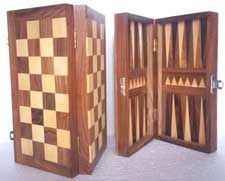
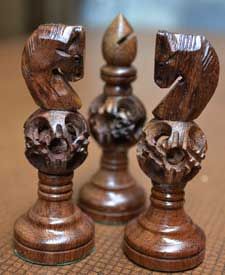
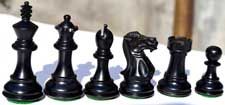
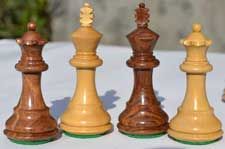

Staunton chess set
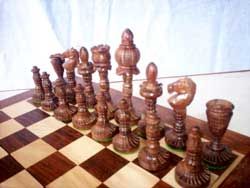
The Staunton chess set is composed of a particular type of chess pieces used to play the game of chess. According to the rules of chess, this style is to be used for competitions. Nathaniel Cook is credited with the design, and they are named after Howard Staunton. The first 500 sets were hand signed and numbered by Staunton. This style of set was first made available by Jaques of London in 1849, and they quickly became the standard. They have been used around the world since
 The increased interest in the game of chess,
particularly in international play during the late 18th century and
early 19th century, brought about a renewed demand for a more universal
model for chess pieces.
The variety and styles of the conventional form, begun in the 15th
century, had expanded tremendously by the beginning of the nineteenth
century. Conventional types popular during the period included the
English Barleycorn chess set, the St. George chess set, the French Regence chess set (named after the Café de la Régence in Paris) and the central European Selenus chess set.
Most pieces were tall, easily tipped and cumbersome during play, but
their major disadvantage was the similarity of the pieces within a set. A
player's unfamiliarity with an opponent's set could alter the outcome
of a game.
The increased interest in the game of chess,
particularly in international play during the late 18th century and
early 19th century, brought about a renewed demand for a more universal
model for chess pieces.
The variety and styles of the conventional form, begun in the 15th
century, had expanded tremendously by the beginning of the nineteenth
century. Conventional types popular during the period included the
English Barleycorn chess set, the St. George chess set, the French Regence chess set (named after the Café de la Régence in Paris) and the central European Selenus chess set.
Most pieces were tall, easily tipped and cumbersome during play, but
their major disadvantage was the similarity of the pieces within a set. A
player's unfamiliarity with an opponent's set could alter the outcome
of a game.
By the early decades of the 19th century, it was all too clear that there was a great need for a chess set with pieces that were easy to use and universally recognized by chess players of diverse backgrounds. The solution, first released in 1849 by the purveyors of fine games, John Jaques of London, sport and games manufacturers, of Hatton Garden, London England, was to become known as the Staunton chess set after Howard Staunton (1810–1874), the chess player and writer who was generally considered the strongest player in the world from 1843 to 1851.
Although Nathaniel Cook has long been credited with the design, it may have been conceived by his brother-in-law and owner of the firm, John Jaques.
However, chess books of the day were using icons of chess pieces in diagrams of a design similar in many respects to the Staunton men from 1818. This indicates that the Staunton design was taken from these diagrams. An idea very likely picked up by a printer.[4]
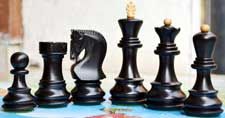
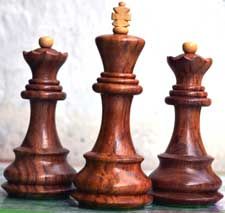
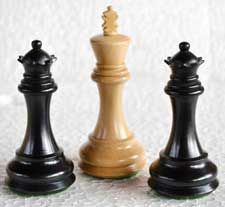
The Staunton pieces broadly resemble columns with a wide molded base. Knights feature the sculpted head and neck of a horse. Kings, the tallest pieces, top the column with a stylised closed crown topped with a cross pattée. Queens are slightly smaller than kings, and feature a coronet topped with a tiny ball. Rooks feature stylised crenellated battlements and bishops a Western-style mitre. Pawns are the smallest and are topped by a plain ball. Pieces representing human characters (the king, queen, bishop, and pawn) have a flat disk separating the body from the head design; this is called a collar.
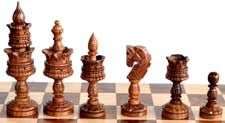
Old style chess sets

A St. George style set
By the early decades of the 19th century, it was all too clear that there was a great need for a chess set with pieces that were easy to use and universally recognized by chess players of diverse backgrounds. The solution, first released in 1849 by the purveyors of fine games, John Jaques of London, sport and games manufacturers, of Hatton Garden, London England, was to become known as the Staunton chess set after Howard Staunton (1810–1874), the chess player and writer who was generally considered the strongest player in the world from 1843 to 1851.
Although Nathaniel Cook has long been credited with the design, it may have been conceived by his brother-in-law and owner of the firm, John Jaques.
- First theory
- Second theory
- Third theory
However, chess books of the day were using icons of chess pieces in diagrams of a design similar in many respects to the Staunton men from 1818. This indicates that the Staunton design was taken from these diagrams. An idea very likely picked up by a printer.[4]
Design
The ebony and boxwood sets were weighted with lead to provide added stability and the underside of each piece was covered with felt. This afforded the players the illusion that the chessmen were floating across the board. Some ivory sets were made from African ivory. The king sizes ranged from 3 1⁄2 to 4 1⁄2 inches (89 to 114 mm) and the sets typically came in a carton-pierre case, each one bearing a facsimile of Staunton's signature under the lid.The Staunton pieces broadly resemble columns with a wide molded base. Knights feature the sculpted head and neck of a horse. Kings, the tallest pieces, top the column with a stylised closed crown topped with a cross pattée. Queens are slightly smaller than kings, and feature a coronet topped with a tiny ball. Rooks feature stylised crenellated battlements and bishops a Western-style mitre. Pawns are the smallest and are topped by a plain ball. Pieces representing human characters (the king, queen, bishop, and pawn) have a flat disk separating the body from the head design; this is called a collar.
Patent
Jaques then approached his brother-in-law for advice. At the Patent Office, on March 1, 1849, Nathaniel Cook, 198 Strand, London, England, registered an Ornamental Design for a set of Chess-Men, under the Ornamental Designs Act of 1842. At that date, there was no provision for the registration of any design or articles of ivory; registration was limited to Class 2, articles made chiefly of woodcheckmateindia.com
-
 Add to Cart$45.00
 -
 Add to Cart$45.00
 -
 Add to Cart$20.00
 -
 Add to Cart$20.00
 -
 Add to Cart$45.00
 -
 Add to Cart$40.00
 -
 Add to Cart$45.00
 -
 Add to Cart$45.00
Latest ProductsSee New Products
-
 Add to Cart$18.00
 -
 Add to Cart$10.00
 -
 Add to Cart$10.00
 -
 Add to Cart$5.00
 -
 Add to Cart$30.00
 -
 Add to Cart$30.00
 -
 Add to Cart$18.00
 -
 Add to Cart$40.00
 -
 Add to Cart$45.00
 -
 Add to Cart$45.00
 -
 Add to Cart$18.00
 -
 Add to Cart$18.00
 -
 Add to Cart$18.00
 -
 Add to Cart$18.00
 -
 Add to Cart$18.00
 -
 Add to Cart$18.00
 -
 Add to Cart$15.00
 -
 Add to Cart$15.00
 -
 Add to Cart$40.00
 -
Add to Cart$40.00
-
Add to Cart$45.00
-
Add to Cart$20.00
-
 Add to Cart$15.00
Subscribe to:
Comments (Atom)